

Bladder control problems are common in both men and women, yet most people are left scratching their head at the pharmacy shelf, overwhelmed by options. The right choice usually depends on many factors like the type/level of leakage, mobility, daily routine and more.
That’s a lot to weigh in on, so some direction can be helpful. Drawing from hands-on care experience, this guide compares the six main product types so you can get the best incontinence products to suit your needs.
Understanding the Types and Levels of Incontinence
Before comparing products, get clear on two things: the kind of incontinence and how much leakage happens. The 5 types of urinary incontinence are:
Type | What happens |
Stress | Leaks under pressure like coughing, sneezing, or lifting |
Urge | Sudden, strong need to urinate with little warning |
Overflow | Bladder never empties fully, so it drips between visits |
Functional | A physical or cognitive barrier stops you from reaching the toilet in time |
Mixed | Two or more of the above together, most often stress and urge |
There’s also bowel incontinence (unable to control stool), so always check what a product is rated for before buying. The distinction changes the product you need.
Urinary issues call for a product that absorbs liquid fast and locks it away. Bowel issues need containment and a snug fit around the legs and waist, which usually points to a tab-style brief over a thin pad.
Incontinence Absorbency Levels Explained
Absorbency is measured in milliliters.
Level | Rough volume | Typical use |
Light | 50 to 150 ml | Post-toilet dribbles, small stress leaks |
Moderate | 150 to 300 ml | Larger or more frequent leaks |
Heavy | 300 ml and up | Full bladder voids, limited mobility |
Overnight | Highest capacity | Eight hours without a change |
Types of Incontinence Products Compared
Incontinence Pads and Liners
Adhesive inserts that stick inside regular underwear, including slim male guards shaped to cup the penis.
- Pros: cheapest option, discreet, easy to change, travel well
- Cons: can shift out of place, little side or rear coverage, ongoing waste
- Best for: active people with predictable, lighter leaks
Pull-On Protective Underwear (Pull-Ups)
Full disposable garments, often called pull-ups, that you step in and out of like normal underwear.
- Pros: moderate to heavy absorbency, worn and changed independently, discreet under clothes
- Cons: cost more than pads, can’t open at the side so harder to remove if soiled
- Best for: mobile adults with steady, heavier needs
Tab-Style Briefs (Adult Diapers)
Adult diapers with refastenable tabs at the hips that open completely flat.
- Pros: heavy to maximum absorbency, easy for a carer to change someone lying down
- Cons: bulkier and less discreet, the wearer can’t manage them alone
- Best for: bedridden, wheelchair-using, or carer-assisted situations
Washable Reusable Incontinence Underwear
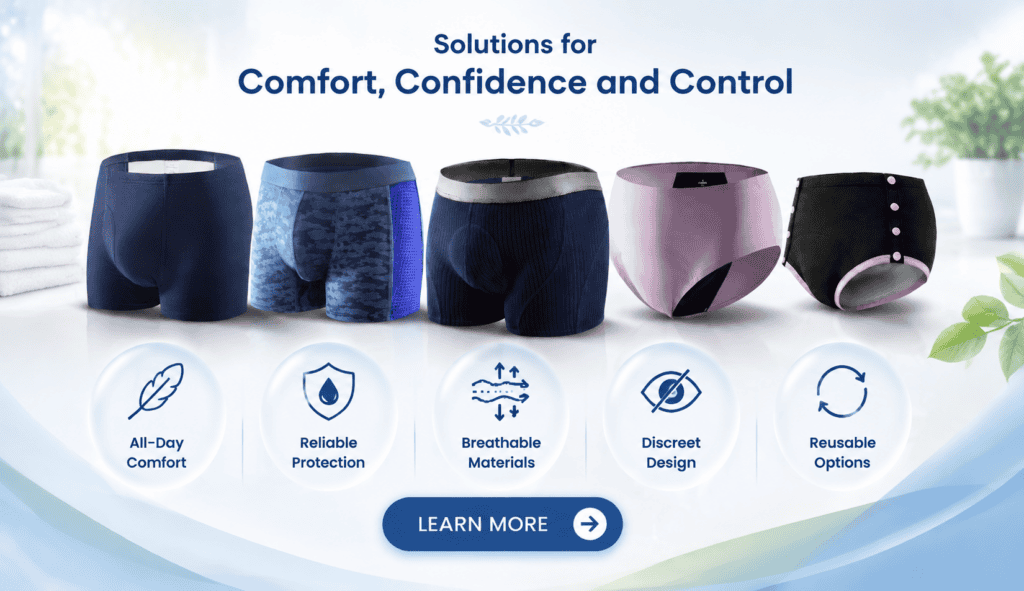
Washable Incontinence Underwear that look and feel like ordinary underwear with an absorbent layer sewn in, so you don’t need a separate pad. You wear it, wash it, and wear it again.
- Pros: reusable so cheaper over time, breathable fabrics, no rustle, far less waste
- Cons: higher upfront cost, needs washing and drying time, a backup set helps
- Best for: light to heavy daily needs, and anyone cost-conscious or Eco-minded
CARER is one of the more developed brands in this category, with separate men’s and women’s lines across five absorbency tiers (Light, Moderate, Heavy, Super, Overnight) in sizes XS to 6XL. Most styles come in single, 3-pack, and 6-pack options, with the larger packs bringing down the price per piece.
A sample of the range:
Style | For | Tier | Capacity | Single | 6-pack (per piece) | Notes |
M74 boxer brief | Men | Light | ~80 ml | $25.95 | $116.78 ($19.46 each) | Front pouch, OEKO-TEX, breathable stretch blend |
M90 trunk | Men | Moderate | ~150 ml | $29.98 | $134.91 ($22.49 each) | 95% bamboo, front-to-back pad, OEKO-TEX |
M67 trunk | Men | Heavy | ~300 ml | $40.99 | $172.16 ($28.69 each) | 100% cotton, front-to-back pad for side sleepers |
P32 brief | Women | Light | ~60 ml | $19.95 | $88.58 ($14.76 each) | Doubles for periods |
W11 side-snap | Women | Heavy | ~200 ml | $29.99 | $134.96 ($22.49 each) | Snaps open flat for carer changes |
Materials matter for skin health. Carer men’s leakproof underwear uses 100% cotton on several styles, a 95% bamboo blend on others like the M80 and M90 to wick moisture and resist odor, and a breathable stretch blend on slim trunks like the M74.
The fabrics are PFAS-free, many carry OEKO-TEX certification, and several men’s styles include a functional fly. A recent addition, the M95 Side-Snap Incontinence Briefs, extends the washable range to caregiver-assisted use.
Reinforced side snaps open the brief flat for quick changes while standing, sitting, or lying down, and a 250 ml front-to-back core handles moderate to heavy needs. Care is simple with this range.
Every CARER underwear just needs a cold rinse or a delicate wash below 30°C, followed by a hang dry, with no fabric softener since it clogs the absorbent layer. Orders ship in plain, unbranded packaging, and a 60-day risk-free trial lets you test whether reusable suit your needs.
Booster Pads
A thin insert with no waterproof backing that you place inside another product to add capacity. Liquid passes through it into the main garment below.
- Pros: cheap, extends overnight protection without a full change
- Cons: only works paired with another product
- Best for: stretching capacity during long stretches between changes
Underpads for Bed and Chair Protection
Underpads that protect mattresses, chairs, and car seats rather than the body.
- Pros: disposable versions suit travel and heavy nights, washable versions cut long-term cost
- Cons: guard surfaces only, so they back up a worn product rather than replace it
- Best for: overnight mattress protection and furniture
Incontinence Products Comparison Chart
Product type | Best for | Absorbency | Ease of change | Type | Typical US price |
Pads and liners | Light leaks, discretion | Light to moderate | Easiest (adhesive) | Disposable | $0.15 to $0.80 per pad |
Pull-on underwear | Active, independent adults | Moderate to heavy | Easy (step in and out) | Disposable | $0.30 to $1.00 per piece |
Tab-style briefs | Limited mobility, carer help | Heavy to maximum | Easy (open and close tabs) | Disposable | $0.50 to $2.00 per piece |
Washable underwear | Light to heavy, eco or cost-conscious | Light to heavy | Easy (like normal underwear) | Reusable | $15 to $40 per garment, reused for months |
Booster pads | Extra capacity inside another product | Adds capacity | Add inside garment | Disposable | $0.15 to $0.70 per pad |
Underpads | Bed and furniture protection | Surface only | Place and replace | Both | $0.30 to $2.00 disposable, $10 to $30 washable |
Approximate US retail prices per unit. Store brands sit at the low end, premium and overnight products at the high end.
How to Choose the Right Incontinence Product
Work through these in order:
- Type and level of leakage. Match capacity to real volume in millilitres.
- Mobility and dexterity. Someone who can’t step into a garment needs tab-style or side-snap openings.
- Self-managed or carer-assisted. This decides between pull-ons and openable briefs.
- Day versus night. Overnight almost always needs more capacity.
- Discretion and lifestyle. Quiet, slim, plain-packaged products matter for confidence.
- Budget. Count cost across weeks, not single packs.
- Skin sensitivity. Breathable cotton or bamboo beats plastic backing for at-risk skin.
How to Get the Right Size and Absorbency
Sizing Incontinence Underwear and Briefs
- Tab-style and most washable briefs are sized by waist measurement.
- Pull-ons often use a mix of waist, height, and weight.
- Clothing size doesn’t transfer, so measure with a tape.
- Between two sizes, size up for comfort and a better leak seal.
How to Read Absorbency Ratings
- Droplet or cup icons show relative capacity. More droplets mean more absorbency.
- The icon scale isn’t standard across brands, so one maker’s four droplets may not match another’s.
- Where a product lists an actual millilitre or fluid-ounce figure, trust it over the icons.
How to Prevent Skin Irritation and Protect Dignity
Prolonged contact with moisture causes incontinence-associated dermatitis (IAD), a painful breakdown of the skin. Three habits prevent it:
- Change promptly once a product is wet.
- Use a barrier cream on at-risk skin.
- Choose breathable materials that let heat escape, where washable cotton and bamboo have an edge over plastic-backed disposables.
Dignity matters as much as skin. A product that looks like normal underwear, makes no rustling sound, and arrives in plain packaging removes a real source of embarrassment for the wearer and eases the task for the carer.
Cost of Disposable vs Reusable Incontinence Products
Per pack, disposables look cheap. Day after day, they add up. Someone using about four disposable pull-ups a day spends roughly $450 to $1,500 a year, with heavy and overnight users at the top of that range or beyond.
Reusables flip the math. A set of CARER washable underwear costs more on day one, but each garment survives many wash cycles and replaces a steady stream of disposables, so it pays for itself within weeks of daily use.
Approach | What you buy | Rough first-year cost |
Disposable pull-ups | About 4 a day, restocked every week | $450 to $1,500 |
CARER washable underwear | A set of 6 to 7, washed and reused | $140 to $290 |
Illustrative US costs for moderate daily use. Actual spend depends on absorbency level and how often you change.
For steady light to moderate daily leakage, washables like CARER usually work out cheaper within the first couple of months and save hundreds of dollars a year after that, while cutting the plastic that disposables send to landfill.
The fair exceptions are heavy and overnight protection, where many people still add a booster pad or keep disposables for travel. A practical setup is a CARER rotation for daily wear, with disposables held back for the situations that need maximum capacity.
When to See a Doctor About Incontinence
Products manage the symptom but not the cause. See a doctor if leakage is:
- New or rapidly worsening
- Painful, or paired with blood
- Stopping you from your daily activities
Pelvic floor training, bladder training, and a medical review can reduce or resolve incontinence that no product addresses. Treat these products as comfort tools while you pursue the underlying issue.
Choosing the Right Incontinence Product for Your Needs
The right incontinence product improves comfort and confidence rather than just catching leaks. Match it to the type and level of leakage, the person’s mobility, and who manages care, then adjust as needs change. Starting with a sample or a trial-backed pack, like CARER’s 60-day risk-free first order, lets you test fit and absorbency before committing, which is the fastest route to getting it right.
Exclusive Offer for NAFC Readers
Get Carer leakproof underwear for men and women exclusively online at carerspk.com.
Use code NAFC15 at checkout to receive a 15% discount. Visit carerspk.com to explore the collection.

This article was developed in partnership with, and sponsored by Carer. NAFC collaborates with select partners to bring our community information and resources that support bladder and bowel health.







3 Responses
Here’s my experience with men’s Depends light and Carer M74 reusable briefs.
After successful RARP seven years ago I am a light stress leaker, about 10ml/day (5-25ml), as measured by weighing a 6g (dry) Depends light pad each morning after 24 hours use for several years. I have primarily used the Depends (or equivalent) pad with a Speedo bathing suit (brief) to hold the pad in place. Reusable pads haven’t been absorbent enough so I was excited to try the newer reusable pullups/briefs, including Carer products like M74. It is important to me to avoid the landfill waste of disposables. In large part, I found them very well-made and thoughtfully designed. However, after almost a year using them I have had to go back to Depends until the product is revised in two ways to suit my particular situation.
1) Although they appear to be quite absorbent in terms of volume, they remain moist on the surface against my skin. This has resulted in skin breakdown, extreme sensitivity, and sometimes bacterial or fungal growth. I have used Aquaphor and other products as a moisture barrier. It helps mitigate the moisture but not enough to significantly improve my quality of an active life (especially in summer).
2) The absorbent cup sewn edge rubs the broken-down scrotum skin raw. Dime-sized lesions have formed as a result. They are very painful and take almost a week to heal with Aquaphor and reverting back to the drier Depends pad.
I believe I could modify the product to cover the rough edge by sewing a flap of material over it but the surface moisture problem will still be there. I am hoping Carer will continue evolving their product to handle these situations. I use the M74 every night now to get relief from the Depends and bathing suit as I sleep on my back and I only leak ~2ml/night.
I hope this level of detail is useful to others and I would very much like to hear about others’ experience in the “very light leakage” category. Thanks for your work, NAFC!
Its nice to see articles helping people choose the right incontinence product. I don’t like to see however, all articles directing the active male away from the diaper (3 tab style). I’m a very active male with pretty bad urge incontinence and have found the full diaper is the absolute best. Because I’ll have several leaks during the day – I have to change once or twice a day. I find the full diaper so much better for ensuring there are no leaks and they are absolutely the best for changing without taking all of your clothes off in a work bathroom stall for example.
I’m disappointed to hear constantly that the full diapers are only for the people in wheel chairs.
Your title is a “complete comparison” which I was quite encourage to read . However I find it isn’t a complete comparison of the best incontinent products only of a selected few . I use a condom catheter daily and a similar device at night but I saw no comparison of these products which I would have found informative . There are a number of other devices used for IC but they were not mentioned either .. disappointing