


Search
[give_form id="19690"]

Downloadable Exercises For Your Pelvic Floor

Search

JOIN OUR NEWSLETTER

Receive custom tools to help you manage your condition and get the latest in bladder and bowel health from NAFC!

Downloadable Pelvic Floor Exercise Sheets

Keeping your pelvic floor healthy and strong is a daily effort. Just as with normal strength training and exercise, it’s important to regularly work your pelvic floor so it can fully contract, relax and function properly. Regular pelvic floor workouts also help to prevent other problems, such as urinary incontinence.

Click the images below to download these workout sheets and work with your pelvic floor physical therapist to develop a routine that works best for you!

Note: Always check with your doctor or PT prior to beginning any new exercise routine.

Download Your Free Toolkit First!

Prior to downloading the individual exercises below, we urge you to download our FREE Pelvic Floor Muscle Training Toolkit, which provides education on how to keep your pelvic floor healthy, information on how pelvic floor muscle training can help, and a step-by-step guide to doing Kegels, among other informative brochures. 

Difficulty Level: Easy - All Fitness Levels

DiaphragmaticBreathing 1
Pelvic Floor exercises
TransverseAbdominus 1
TransverseAbdominus BracingWhileSitting 1
POSTERIOR PELVIC TILT
Brace Supine Marching
Single Knee to Chest Stretch
DOUBLE KNEE TO CHEST STRETCH
Exercise Ball Marching
Bridge With Arms Crossed
Isometric Oblique Stabilization
Lower Trunk Rotation
Sahrmann Level 1
Sahrmann Level 1
Sahrmann Level 2
Sahrmann Level 2
Seated Marching With Elastic Band
Standing Marching
Standing Marching
Abdominal Crunch
Abdominal Crunch
Bridge With Toes Up
Bridge With Toes Up
Bird Dog Arms Only
Bird Dog Arms Only
Mini Squat
Mini Squat
Plie Squat
Plie Squat
Seated Marching Alternate Arms Legs
Standing Marching Single Leg
Wall Push Ups
Wall Push Ups
Weight Shift Lateral
SEATED OBLIQUE ROTATION
Seated Oblique Rotation

Difficulty Level: Moderate

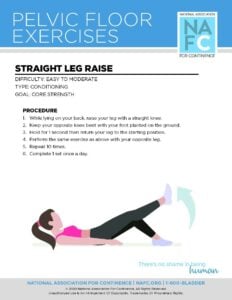
StraightLegRaise
Straight Leg Raise
dying bug
Dying Bug
oblique reaches
Oblique Reaches
Illustration of a woman lying on her back with knees bent, performing a partial curl-up for obliques. Instructions and steps are listed, with pelvic floor exercises as the main topic. Includes Downloadable Exercises For Your Pelvic Floor.
Partial Curl Up - Obliques
pelvic tilt with crunch
Pelvic Tilt With Crunch
bird dog - quadruped hip extension downloadable worksheet.
Bird Dog Option 2: Quadruped Hip Extension
exercise ball seated alternate arms legs
Exercise Ball - Seated, Alternate Arms & Legs
single leg stance reach forward
Single Leg Stance - Reach Forward
Bridge With Adduction

Difficulty Level: Difficult

Supine 90 90 Marching spelvic bracing
Looped Elastic Band Hip Flexion Extension
Foam Roll Marching
Foam Roll Marching
Dumbell Pull Over
Dumbell Pull Over
Unsuported Bicycle Brace
Bird Dog Quadruped Alternate Arm Leg
Lateral Lunge Difficult
Bird Dog Exercises
Bird Dog Exercises

Difficulty Level: Very Difficult

Elastic Band Bicycle Brace
Side Plank Crunches
Side Plank Crunches
Supine Crunch Touch
Supine Crunch Touch
 

NOTE: The information shared within NAFC’s Pelvic Floor Health Center is meant to be used as a guide but should not be considered a replacement for medical advice. Not all pelvic floor exercises are for everyone, and we strongly urge you to talk to your doctor before beginning any new workout routine, and, if possible, see a physical therapist trained in pelvic floor health to receive a diagnosis and treatment recommendation.

RELATED ARTICLES

Five women of varying ages stand close together, smiling and laughing. The text discusses vital conversations on health—from postpartum to incontinence after prostate cancer surgery—on the Life Without Leaks NAFC podcast.

From Postpartum to Postmenopause: The Conversations Women Need to Have

In this episode of Life Without Leaks, we’re joined by Dr. Barbara Frank of Harvard Medical School and Brigham and Women’s Hospital, along with Alex Fennell, co-founder of Attn: Grace, an innovative manufacturer of incontinence products.

Together, we explore the realities of bladder leaks and pelvic floor health during pregnancy, postpartum recovery, perimenopause and menopause, and we discuss why more women are finally beginning to talk more openly about their experiences.

The conversation covers:
• The connection between hormones, menopause and bladder leaks
• Why pelvic floor therapy is having a major moment
• The surprising relationship between pelvic floor tension and incontinence
• How products can impact skin health, comfort and UTIs
• The truth about hormone replacement therapy
• Why community and conversation matter so much in women’s health

Alex also shares the story behind Attn: Grace and the company’s mission to create cleaner, plant-based incontinence products designed to support women with comfort, dignity and confidence.

Whether you’re navigating postpartum recovery, menopause symptoms or simply looking to better understand pelvic health, this episode offers expert insights, practical advice and an encouraging reminder that no one should feel alone in these experiences.

A person sitting on a beige bath mat is placing an incontinence pad into their underwear for skin protection. A box labeled Attn: Grace with blue designs sits on the mat nearby.

Ask The Expert: From A Doctor’s Perspective What Are Some Common Questions You Hear?

If you’ve ever sneezed and held your breath hoping for the best, you’re not alone. Bladder leaks, pelvic floor issues, and the constellation of symptoms that go with them are incredibly common — and incredibly under-discussed. We sat down with two of our favorite experts who are changing the bladder leak conversation: Dr. Barbara Frank, Attn: Grace medical advisor and board certified OB/GYN, and Dr. Sara Reardon, pelvic floor physical therapist (and the woman your pelvic floor has been waiting to meet). They took turns asking each other the questions their patients ask most — and answered them with the same candor they bring to the exam room. They cover everything from how to prepare for postpartum, to what question to ask your own pelvic floor PT, to how to manage incontinence during menopause. This is a knowledge drop you don’t want to miss.

Two older women smiling and walking together on a sunny neighborhood sidewalk, one holding a coffee cup. Both enjoy the confidence provided by discreet incontinence products for women. Trees and houses line the street in the background.

How Aging Changes Bladder Control — What Most People Don’t Expect

As an RN who’s worked in geriatrics for over 14 years, I know first hand that changes in bladder control can be a common part of aging. However, what I’ve also learned is that the treatment and management of these changes differ depending on whether they are due to aging or other conditions.
If you’re experiencing more frequent trips to the bathroom or sudden, intense urges to urinate, you might be wondering what is going on and what you can do about it. Let’s talk through some of the changes that might be going on in your body and how you can be better prepared to manage your bladder control.

Five women of varying ages stand close together, smiling and laughing. The text discusses vital conversations on health—from postpartum to incontinence after prostate cancer surgery—on the Life Without Leaks NAFC podcast.

From Postpartum to Postmenopause: The Conversations Women Need to Have

In this episode of Life Without Leaks, we’re joined by Dr. Barbara Frank of Harvard Medical School and Brigham and Women’s Hospital, along with Alex Fennell, co-founder of Attn: Grace, an innovative manufacturer of incontinence products.

Together, we explore the realities of bladder leaks and pelvic floor health during pregnancy, postpartum recovery, perimenopause and menopause, and we discuss why more women are finally beginning to talk more openly about their experiences.

The conversation covers:
• The connection between hormones, menopause and bladder leaks
• Why pelvic floor therapy is having a major moment
• The surprising relationship between pelvic floor tension and incontinence
• How products can impact skin health, comfort and UTIs
• The truth about hormone replacement therapy
• Why community and conversation matter so much in women’s health

Alex also shares the story behind Attn: Grace and the company’s mission to create cleaner, plant-based incontinence products designed to support women with comfort, dignity and confidence.

Whether you’re navigating postpartum recovery, menopause symptoms or simply looking to better understand pelvic health, this episode offers expert insights, practical advice and an encouraging reminder that no one should feel alone in these experiences.