Search
[give_form id="19690"]

Why You Are Asking The Wrong Questions When It Comes To Incontinence Treatment. It’s Not About The Best Absorbent Products.

If you’re reading this, you are likely one of the hundreds of millions of people who have incontinence. We understand you may be frustrated, or resigned, or embarrassed with your condition. However, something has to be done, because doing nothing means staying at home, or never sneezing, or never running, or never hiking. Doing nothing isn’t an option, so with time, you learn how to manage your incontinence.. In truth, it is typically incontinence symptoms that get dealt with.

Let’s just address the elephant in the room. Incontinence is BIG business. People will pay to not be embarrassed with leaks, and to be able to get back to some activities. So the questions most people ask and search for are: 

  • What are the best incontinence products? 
  • What are the best incontinence pads? 
  • What are the best incontinence pads for night time? 
  • What are the best incontinence products for elderly? 
  • What are the best incontinence pads for women?

Let’s be clear. When we say best, we mean “holds the most urine”, “is least expensive”, “provides the most value for your money”, “doesn’t leak,” and “stays secure.” Or perhaps you are like my friend Carrie, in which case “best incontinence products” means “least irritating”, “no dyes”, “no harmful chemicals”, “best cover of smell.”

But here’s something that you may not realize. When you are asking about the “best” incontinence product, you are asking the wrong question!!


Absorbents Don’t Treat The Issue

Using incontinence products is often a necessity for many people with bladder leaks, and it’s nothing to be ashamed of. However, when you only manage your symptoms with absorbent products, you’re not doing anything to actually treat the condition.

The World Health Organization at one point said Incontinence was the largest health problem that was reversible. That means it is treatable, and it is preventable. How? It helps to understand the root of the problem. 

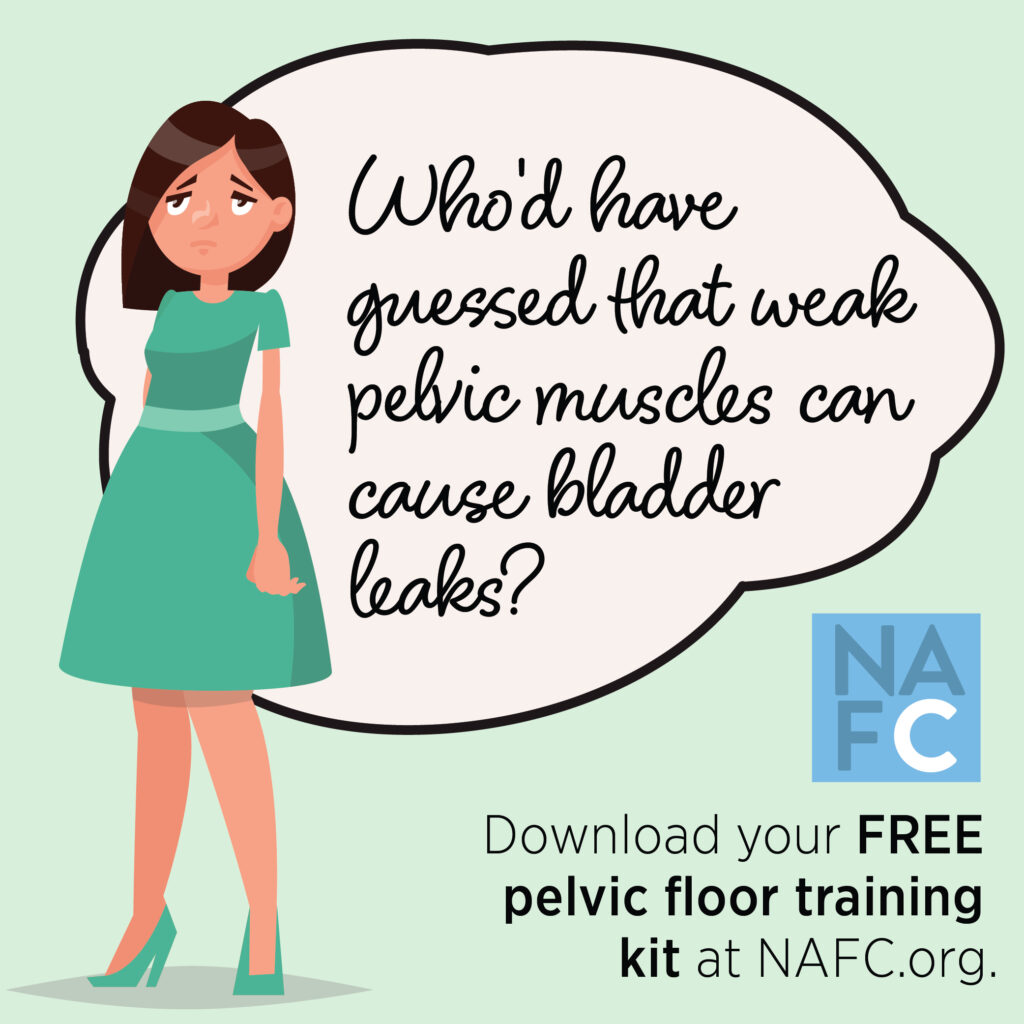
The pelvic floor muscles are responsible for a lot of things, but one of the biggest things they do is to hold urine when your bladder becomes full or you have a need to go to the bathroom. Many people don’t realize until it’s too late that these muscles, like any other muscle in the body, need to be conditioned to stay strong and healthy. 

Many people ignore their pelvic floor muscles, causing the muscles to get too weak to hold urine in the bladder under pressure. This can result in leaking when people experience pressure on the bladder due to things like coughing, sneezing, or laughing, and is called stress incontinence.   To treat this condition, the muscle needs to be strengthened and toned. 

Another type of bladder issue many people experience is an Overactive Bladder. This occurs when the muscles of your bladder contract on their own, even when your bladder is not very full. This causes a need to empty your bladder urgently and often.  When your pelvic floor muscles are very weak, those sudden urges can turn into incontinence. And, if left untreated, incontinence can get worse over time.

So then, knowing that incontinence will usually get worse if I do nothing, what are the right questions? 

  • “What treatments are available?” 
  • “What is the best treatment for my type of incontinence?”

and especially:

  • What is the most conservative (least invasive/least intrusive) treatment for my incontinence?  (You can always try more invasive, such as surgery, later.)

These are the best questions to ask because they get to the root of the problem. Finding the right treatment can start to reverse incontinence and many treatments are quite cost-effective. Many people don’t get treatment because they simply think “I don’t want surgery.” But there are many more conservative, affordable, and easy-to-use treatments

Conservative means least invasive, but have you also considered least intrusive on your lifestyle? There are non-vaginal wearable treatments, such as ELITONE that help you strengthen your pelvic floor muscles while you walk around and do other things. You don’t have to be stationary or indecent such as with a vaginal device. 

Think You Can’t Afford Treatment? Conser The Cost Of Absorbent Products.

The word “treatment” itself may sound expensive. But that entirely depends on the type of treatment you and your doctor decide upon. There are lots of affordable treatment options available, and in many cases, your treatment may be covered by insurance.   

The cost of an absorbent pad may not seem like much per package, but the costs add up and in the long-run will likely cost you more. A video by Dr. Sebesta from Vanderbilt University referenced a recent study showing that women with severe leaks were spending $35 a week on incontinence products. That’s over $1800 a year! Way more than the cost of a treatment device. Many of the treatment devices even offer payment plans to bring it down $35/month. That’s already big cost savings!

So asking “what’s the best incontinence product” is not the answer. Learning more about how to treat the root of your incontinence will give you more control over your condition and help you eliminate the need for pads for good.  

Comments

Related Articles

Five women of varying ages stand close together, smiling and laughing. The text discusses vital conversations on health—from postpartum to incontinence after prostate cancer surgery—on the Life Without Leaks NAFC podcast.

From Postpartum to Postmenopause: The Conversations Women Need to Have

In this episode of Life Without Leaks, we’re joined by Dr. Barbara Frank of Harvard Medical School and Brigham and Women’s Hospital, along with Alex Fennell, co-founder of Attn: Grace, an innovative manufacturer of incontinence products.

Together, we explore the realities of bladder leaks and pelvic floor health during pregnancy, postpartum recovery, perimenopause and menopause, and we discuss why more women are finally beginning to talk more openly about their experiences.

The conversation covers:
• The connection between hormones, menopause and bladder leaks
• Why pelvic floor therapy is having a major moment
• The surprising relationship between pelvic floor tension and incontinence
• How products can impact skin health, comfort and UTIs
• The truth about hormone replacement therapy
• Why community and conversation matter so much in women’s health

Alex also shares the story behind Attn: Grace and the company’s mission to create cleaner, plant-based incontinence products designed to support women with comfort, dignity and confidence.

Whether you’re navigating postpartum recovery, menopause symptoms or simply looking to better understand pelvic health, this episode offers expert insights, practical advice and an encouraging reminder that no one should feel alone in these experiences.

A person sitting on a beige bath mat is placing an incontinence pad into their underwear for skin protection. A box labeled Attn: Grace with blue designs sits on the mat nearby.

Ask The Expert: From A Doctor’s Perspective What Are Some Common Questions You Hear?

If you’ve ever sneezed and held your breath hoping for the best, you’re not alone. Bladder leaks, pelvic floor issues, and the constellation of symptoms that go with them are incredibly common — and incredibly under-discussed. We sat down with two of our favorite experts who are changing the bladder leak conversation: Dr. Barbara Frank, Attn: Grace medical advisor and board certified OB/GYN, and Dr. Sara Reardon, pelvic floor physical therapist (and the woman your pelvic floor has been waiting to meet). They took turns asking each other the questions their patients ask most — and answered them with the same candor they bring to the exam room. They cover everything from how to prepare for postpartum, to what question to ask your own pelvic floor PT, to how to manage incontinence during menopause. This is a knowledge drop you don’t want to miss.

Two older women smiling and walking together on a sunny neighborhood sidewalk, one holding a coffee cup. Both enjoy the confidence provided by discreet incontinence products for women. Trees and houses line the street in the background.

How Aging Changes Bladder Control — What Most People Don’t Expect

As an RN who’s worked in geriatrics for over 14 years, I know first hand that changes in bladder control can be a common part of aging. However, what I’ve also learned is that the treatment and management of these changes differ depending on whether they are due to aging or other conditions.
If you’re experiencing more frequent trips to the bathroom or sudden, intense urges to urinate, you might be wondering what is going on and what you can do about it. Let’s talk through some of the changes that might be going on in your body and how you can be better prepared to manage your bladder control.

Five women of varying ages stand close together, smiling and laughing. The text discusses vital conversations on health—from postpartum to incontinence after prostate cancer surgery—on the Life Without Leaks NAFC podcast.

From Postpartum to Postmenopause: The Conversations Women Need to Have

In this episode of Life Without Leaks, we’re joined by Dr. Barbara Frank of Harvard Medical School and Brigham and Women’s Hospital, along with Alex Fennell, co-founder of Attn: Grace, an innovative manufacturer of incontinence products.

Together, we explore the realities of bladder leaks and pelvic floor health during pregnancy, postpartum recovery, perimenopause and menopause, and we discuss why more women are finally beginning to talk more openly about their experiences.

The conversation covers:
• The connection between hormones, menopause and bladder leaks
• Why pelvic floor therapy is having a major moment
• The surprising relationship between pelvic floor tension and incontinence
• How products can impact skin health, comfort and UTIs
• The truth about hormone replacement therapy
• Why community and conversation matter so much in women’s health

Alex also shares the story behind Attn: Grace and the company’s mission to create cleaner, plant-based incontinence products designed to support women with comfort, dignity and confidence.

Whether you’re navigating postpartum recovery, menopause symptoms or simply looking to better understand pelvic health, this episode offers expert insights, practical advice and an encouraging reminder that no one should feel alone in these experiences.