Search
[give_form id="19690"]

Prevalence Of Incontinence In Middle Age Women

Recently, Aeroflow Urology, a national provider of continence care supplies through insurance, surveyed hundreds of women, aged 40-64, to learn more about their journey with incontinence. The results were astonishing.

The poll showed us that while almost ¾ of middle age women are affected by incontinence, there is a large gap in education and resources available to these women as they navigate these changes to their body without help or guidance from their healthcare provider.

Incontinence In Middle Age Women, By The Numbers:

Prevalence

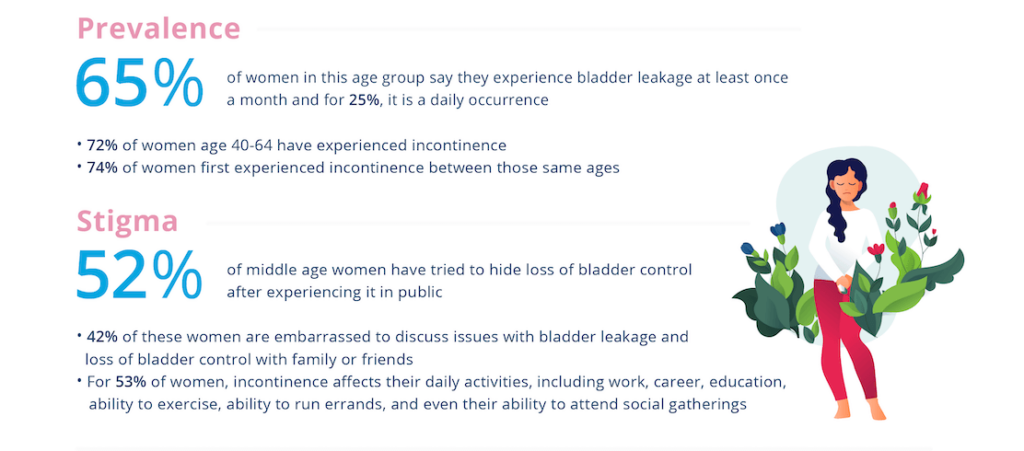
  • Incontinence is very common among women aged 40-64, with 72% having experienced it and 74% of women first experiencing incontinence between those same ages.
  • 65% say they experience bladder leakage at least once a month and for 25% of women, it is a daily occurrence.
ScreenShot2020 05 12at9.28.56AM

Stigma

  • 52% of middle age women have tried to hide loss of bladder control after experiencing it in public, while another 42% are embarrassed to discuss it with family or friends, suggesting the presence of a strong stigma.
  • For over half ( 53%) of women, incontinence affects their daily lives and activities, including work, career, education, ability to exercise, ability to run errands, and even their ability to attend social gatherings.
 

Barriers To Treatment And Education

  • 56% did not visit a doctor after experiencing loss of bladder control, and 37% said they did not seek treatment because they did not think it was a big deal, illustrating a lack of education on incontinence.
ScreenShot2020 05 12at9.29.06AM

“This study confirms what we already suspected: that social stigma and a lack of education about incontinence stand in the way of treatment,” said Aleece Fosnight, Medical Advisor for Aeroflow Urology. “Breaking down those barriers is such an important step in preventative treatment and normalizing incontinence. Without proper treatment, incontinence can snowball into larger health issues such as urinary tract infections, kidney failure, and depression, and can even impact life issues like personal finance.”

Aeroflow Urology is working to be a resource to people of all ages and genders when it comes to living with incontinence. Their mission is not only to educate and bring awareness to incontinence and bladder control, but also to help ease the financial burden of purchasing these needed supplies.

As a provider of continence care supplies through insurance, Aeroflow Urology, helps individuals across the country maximize their insurance benefits to receive high quality supplies at no cost. Their team takes the hassle out of your hands by working directly with insurance and healthcare providers to complete and submit all required paperwork to ensure there is no cost to you.

When working with Aeroflow, you also receive a dedicated and specially trained Continence Care Specialist who will be available to you throughout your continence journey. From sending product samples to troubleshooting issues, the team at Aeroflow Urology makes it easy to get the products you need at no cost through your insurance plan.

Qualifying is quick and simple – all you’ll need is your insurance card. To get started, simply submit your information through their qualification form. Once received, their team will contact you within 1-2 business days to get started.

Join Aeroflow Urology as they work to break the stigma of incontinence through meaningful conversations, educational resources and shared stories. You can follow along and share your story on social media using #incontinenceawareness. Download the Poster with stats from this survey here!

Comments

Leave a Reply

Your email address will not be published. Required fields are marked *

This site uses Akismet to reduce spam. Learn how your comment data is processed.

Related Articles

Five women of varying ages stand close together, smiling and laughing. The text discusses vital conversations on health—from postpartum to incontinence after prostate cancer surgery—on the Life Without Leaks NAFC podcast.

From Postpartum to Postmenopause: The Conversations Women Need to Have

In this episode of Life Without Leaks, we’re joined by Dr. Barbara Frank of Harvard Medical School and Brigham and Women’s Hospital, along with Alex Fennell, co-founder of Attn: Grace, an innovative manufacturer of incontinence products.

Together, we explore the realities of bladder leaks and pelvic floor health during pregnancy, postpartum recovery, perimenopause and menopause, and we discuss why more women are finally beginning to talk more openly about their experiences.

The conversation covers:
• The connection between hormones, menopause and bladder leaks
• Why pelvic floor therapy is having a major moment
• The surprising relationship between pelvic floor tension and incontinence
• How products can impact skin health, comfort and UTIs
• The truth about hormone replacement therapy
• Why community and conversation matter so much in women’s health

Alex also shares the story behind Attn: Grace and the company’s mission to create cleaner, plant-based incontinence products designed to support women with comfort, dignity and confidence.

Whether you’re navigating postpartum recovery, menopause symptoms or simply looking to better understand pelvic health, this episode offers expert insights, practical advice and an encouraging reminder that no one should feel alone in these experiences.

A person sitting on a beige bath mat is placing an incontinence pad into their underwear for skin protection. A box labeled Attn: Grace with blue designs sits on the mat nearby.

Ask The Expert: From A Doctor’s Perspective What Are Some Common Questions You Hear?

If you’ve ever sneezed and held your breath hoping for the best, you’re not alone. Bladder leaks, pelvic floor issues, and the constellation of symptoms that go with them are incredibly common — and incredibly under-discussed. We sat down with two of our favorite experts who are changing the bladder leak conversation: Dr. Barbara Frank, Attn: Grace medical advisor and board certified OB/GYN, and Dr. Sara Reardon, pelvic floor physical therapist (and the woman your pelvic floor has been waiting to meet). They took turns asking each other the questions their patients ask most — and answered them with the same candor they bring to the exam room. They cover everything from how to prepare for postpartum, to what question to ask your own pelvic floor PT, to how to manage incontinence during menopause. This is a knowledge drop you don’t want to miss.

Two older women smiling and walking together on a sunny neighborhood sidewalk, one holding a coffee cup. Both enjoy the confidence provided by discreet incontinence products for women. Trees and houses line the street in the background.

How Aging Changes Bladder Control — What Most People Don’t Expect

As an RN who’s worked in geriatrics for over 14 years, I know first hand that changes in bladder control can be a common part of aging. However, what I’ve also learned is that the treatment and management of these changes differ depending on whether they are due to aging or other conditions.
If you’re experiencing more frequent trips to the bathroom or sudden, intense urges to urinate, you might be wondering what is going on and what you can do about it. Let’s talk through some of the changes that might be going on in your body and how you can be better prepared to manage your bladder control.

Five women of varying ages stand close together, smiling and laughing. The text discusses vital conversations on health—from postpartum to incontinence after prostate cancer surgery—on the Life Without Leaks NAFC podcast.

From Postpartum to Postmenopause: The Conversations Women Need to Have

In this episode of Life Without Leaks, we’re joined by Dr. Barbara Frank of Harvard Medical School and Brigham and Women’s Hospital, along with Alex Fennell, co-founder of Attn: Grace, an innovative manufacturer of incontinence products.

Together, we explore the realities of bladder leaks and pelvic floor health during pregnancy, postpartum recovery, perimenopause and menopause, and we discuss why more women are finally beginning to talk more openly about their experiences.

The conversation covers:
• The connection between hormones, menopause and bladder leaks
• Why pelvic floor therapy is having a major moment
• The surprising relationship between pelvic floor tension and incontinence
• How products can impact skin health, comfort and UTIs
• The truth about hormone replacement therapy
• Why community and conversation matter so much in women’s health

Alex also shares the story behind Attn: Grace and the company’s mission to create cleaner, plant-based incontinence products designed to support women with comfort, dignity and confidence.

Whether you’re navigating postpartum recovery, menopause symptoms or simply looking to better understand pelvic health, this episode offers expert insights, practical advice and an encouraging reminder that no one should feel alone in these experiences.