
[give_form id="19690"]

What Is Neurogenic Bladder?

Search

JOIN OUR NEWSLETTER

Receive custom tools to help you manage your condition and get the latest in bladder and bowel health from NAFC!

Neurological conditions and your bladder

Neurogenic bladder is a condition where a brain, spinal cord, or nerve problem causes you to have trouble controlling your bladder.  Neurogenic bladder can be caused by a variety of neurological diseases and disorders, including multiple sclerosis, Parkinson’s disease, spinal cord injury, stroke, spina bifida, and hydrocephalus (abnormal accumulation of fluid in the brain). These conditions can cause problems with bladder control.

There are also some individuals who do not have a neurological disease or injury but cannot empty their bladder or experience leakage due to abnormal nerve signals to the bladder.

Because treatment and management options for individuals with neurological disorders cannot be generalized, below you will find links to information targeted to specific disease states.

When the brain and body have difficulty communicating, this causes control issues for many bodily functions, including urination and voiding. There are more treatment and management options today than ever before.

The location of the spinal injury has much to say about what sort of incontinence issues might arise. If the injury is above the sacral voiding center, the bladder will probably be overactive and have involuntary bladder contractions. If the injury is at or below the sacral spinal cord, there will be few, if any, bladder contractions.

Commonly in patients with Parkinson’s disease, the bladder becomes overactive and develops unwanted contractions that are difficult or impossible to stop. These often happen at a low volume of filling, resulting in complaints of frequency and urgency. If the bladder contraction causing the sensation of urgency is too strong, leakage may occur, resulting in the complaint, “I can’t hold it.”

Related Articles

Invisible Struggles Living with a Condition You Can't See

But You Look So Good

People with invisible illnesses often face the frustrating question, “But you look so good.” This article explores the impact of this statement on individuals with MS and offers strategies for coping with the challenges of living with an unseen condition.

Invisible Struggles Living with a Condition You Can't See

But You Look So Good

People with invisible illnesses often face the frustrating question, “But you look so good.” This article explores the impact of this statement on individuals with MS and offers strategies for coping with the challenges of living with an unseen condition.
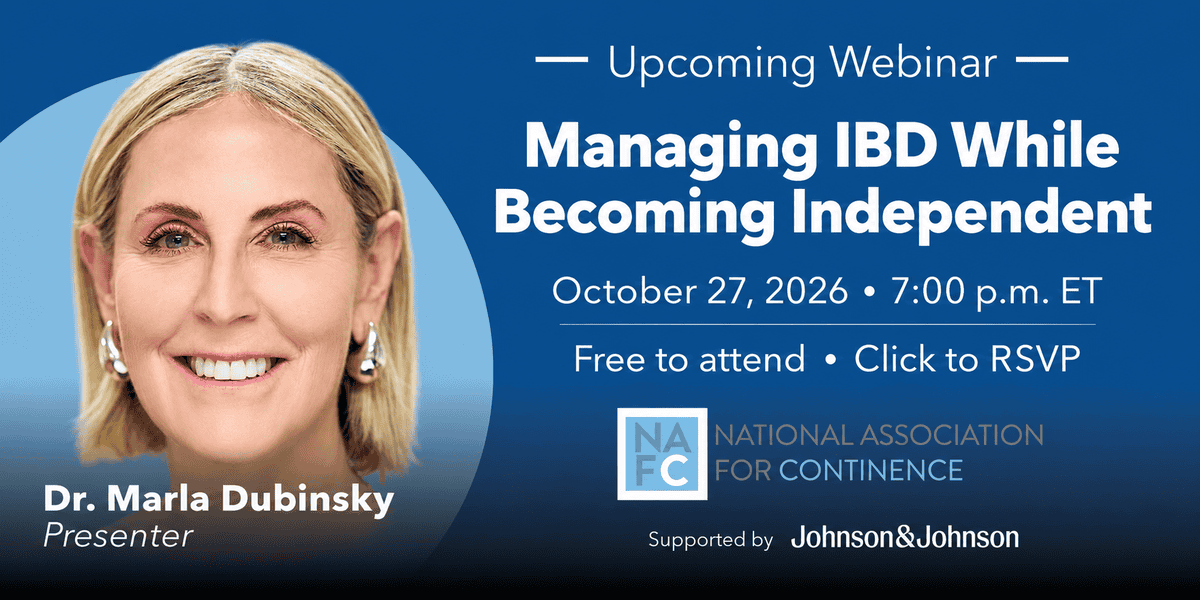
Upcoming webinar titled Managing IBD While Becoming Independent, presented by Dr. Marla Dubinsky on October 27, 2026, at 7:00 p.m. ET, hosted by the National Association for Continence and supported by Johnson & Johnson.

Heading to college, starting a job, or taking more responsibility for your health? Join Dr. Marla Dubinsky for a free webinar on managing Crohn’s disease or ulcerative colitis while becoming more independent. Learn tips for managing medications and appointments, navigating school and social life, and speaking up about your needs. Young adults and the parents or caregivers supporting them are welcome.