
Women's Health And Incontinence Survey Results
JOIN OUR NEWSLETTER
Receive custom tools to help you manage your condition and get the latest in bladder and bowel health from NAFC!
Women's Health & Incontinence: Survey Findings
Earlier this year, NAFC conducted a survey with women to learn more about their experience with bladder health, their approach to seeking help, and their overall feelings about healthcare in general. And while we found that many aspects of their experience were positive, there’s still a lot of work to be done to erase the stigma of incontinence, improve the doctor-patient relationship, and ensure that we are getting the treatment that we need.
Below are a few of our findings.
The Stigma Of Incontinence Is Real
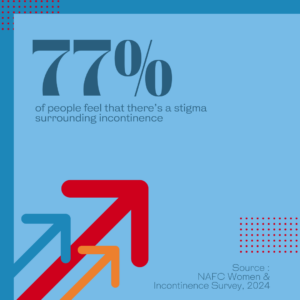
- 77% of women feel there’s a stigma surrounding incontinence.
- Shockingly, 51% had no idea they might experience bladder leaks in their lifetime, highlighting a crucial gap in education.
- 34% suffer in silence, not confiding even in their doctors.
The Takeaway
Let’s face it: no one wants to have incontinence. It can be embarrassing, to say the least, and isn’t exactly dinner party conversation. However, it’s time that we stop staying silent and start speaking up about this condition that affects so many of us. Incontinence is NOT normal and is NOT a normal part of aging. Don’t stay silent: talk to your doctor, and demand treatment.
What You Can Do
Get vocal! This month, we’re sharing all sorts of facts about women’s bladder health and incontinence on Facebook, and Instagram. Click below to follow along with us, engage in the conversation, and share with your friends and family. The more we talk openly about incontinence, the better off we’ll all be.
Understanding the Impact of Incontinence Symptoms
- On average, women experience 4.1 leaks per week, disrupting daily life and impacting emotional and physical well-being.
- Incontinence transcends age, affecting women during perimenopause/post-menopause or after childbirth.
The Takeaway
From unexpected leaks to disrupted sleep, the symptoms of incontinence take a toll on women’s daily lives. It’s not a condition that can just be ignored.
What You Can Do
Become informed! Learn about the many treatment options that are available for bladder leaks. Chances are good that you haven’t exhausted all that’s out there. Then, make an appointment to talk to your doctor about what might work best for you.
Bridging the Gap in Doctor-Patient Communication
- While 74% felt their doctors communicated well, 96% had to initiate the conversation about incontinence.
- Dissatisfaction arises from limited treatment options and unmet expectations.
The Takeaway
While many women commend their doctors’ efforts, there’s a clear need for improved communication regarding incontinence.
What You Can Do
Come prepared for your appointment! As the results of our survey show, chances are strong that you’ll be the one to bring up your incontinence at your doctor’s appointment. Make this conversation as impactful as can be by coming prepared.
Fill out a bladder diary beforehand, educate yourself about the treatments available, and prepare a list of questions to ask your doctor when you see him/her. Advocating for yourself is half the battle.
Navigating the Landscape of Incontinence Treatment
- 73% were prescribed treatments, predominantly medications, yet 41% expressed dissatisfaction due to ineffectiveness.
- Communication gaps often lead to unrealistic expectations.
The Takeaway
From medications to lifestyle changes, there’s a myriad of treatment options available for incontinence. However, our survey reveals gaps in satisfaction and effectiveness.
What You Can Do
First, make sure you know what to expect. Not every treatment works 100% so talk to your doctor about what’s realistic so you won’t be surprised later on.
And, if something really isn’t working for you, speak up! Follow up with your doctor, or make another appointment to talk about alternatives if your first treatment (or second or third) isn’t passing muster.
Advocating for Better Incontinence Care in Healthcare
- Over half feel the healthcare system could take incontinence care more seriously.
- Many delay seeking treatment, prioritizing others’ needs over their own.
- Concerns about rushed appointments and disparities in healthcare based on race/ethnicity persist.
The Takeaway
Incontinence care shouldn’t be an afterthought—it deserves attention and resources within the healthcare system.
What You Can Do
Demand treatment! So many women don’t speak up about their condition because they think it’s not a big enough deal, it’s just a part of getting older, they don’t have time…the list goes on and on.
But staying quiet isn’t doing any of us any favors. Not only will speaking up about incontinence show your doctor it’s something that you take seriously, but it will also show them that it’s something they need to respect as well, making it all the more likely for systems and policies to change moving forward.
This Women’s Health Month, let’s break the silence surrounding bladder health. It’s time to advocate for ourselves, demand better healthcare, and explore comprehensive treatment options. Together, we can overcome stigma and take proactive steps toward optimal bladder health. Join us in prioritizing your well-being—you deserve it.
About Our Survey
NAFC’s Women’s Health And Incontinence Survey was conducted in Q1 of 2024, and was completed by 300 women living with incontinence. Full results of the survey to be available soon in our online store.
Thank You To Our Sponsors
We are thankful to the sponsor of this survey, Cook MyoSite, for helping us raise awareness of women’s bladder health and incontinence, and the many treatment options available to those who live with the condition. Click on the logo below to learn more about them!
RELATED ARTICLES

When To Seek Help For Bladder Leaks
Talking to someone about incontinence can be hard, (most people wait 7 years before seeing a doctor!) but it is often a necessary step in

How I Survive Traveling With Incontinence (and Three Kids)
I’ve never been one of those moms who can fly by the seat of her pants and wing it. Especially when traveling. A mother of

Healthcare Specialties And When To See Them
Have you been thinking about talking to a doctor about your bladder leakage problems, but just can’t muster the courage, or figure out exactly who

Keep Track Of your bladder irritants when it comes to what you eat and drink.
There is a saying that 80% of the results in the gym take place in the kitchen. The same thought could be applied to your